
What Is AI Business Development and How Does It Work?
Business development has changed quickly over the last two years. Most teams have seen it. Prospecting takes too long, outreach is inconsistent, and pipeline depends too much on individual effort.
AI started to enter this space as a way to improve efficiency, but the conversation often stays at a surface level. Tools are introduced, outputs improve, and activity increases. What is less clear is how that actually translates into a system that produces consistent results.
That is why many teams are still asking the same question.
What does AI business development actually mean in practice, and how does it work once it becomes part of a real operation?
What Is AI Business Development?
AI business development refers to the use of artificial intelligence to handle the repetitive parts of pipeline generation, including prospect research, outreach, follow-ups, and initial qualification.
At a basic level, it replaces tasks that are typically manual and time-consuming. Instead of searching for companies, writing messages, and tracking conversations step by step, the system takes over those activities and runs them continuously.
But the difference between AI and traditional automation is not just speed.
Traditional systems rely on fixed rules and sequences. AI systems adapt based on context, signals, and responses. Over time, that creates more relevant targeting, more consistent messaging, and more predictable activity across the pipeline.
This is where the idea becomes more interesting.
Because improving individual tasks is only part of the picture. What matters is whether those improvements translate into how pipeline is actually built and managed across the business.
This is also where many companies start to see why most AI implementation efforts lose momentum.
How Does AI Business Development Work?
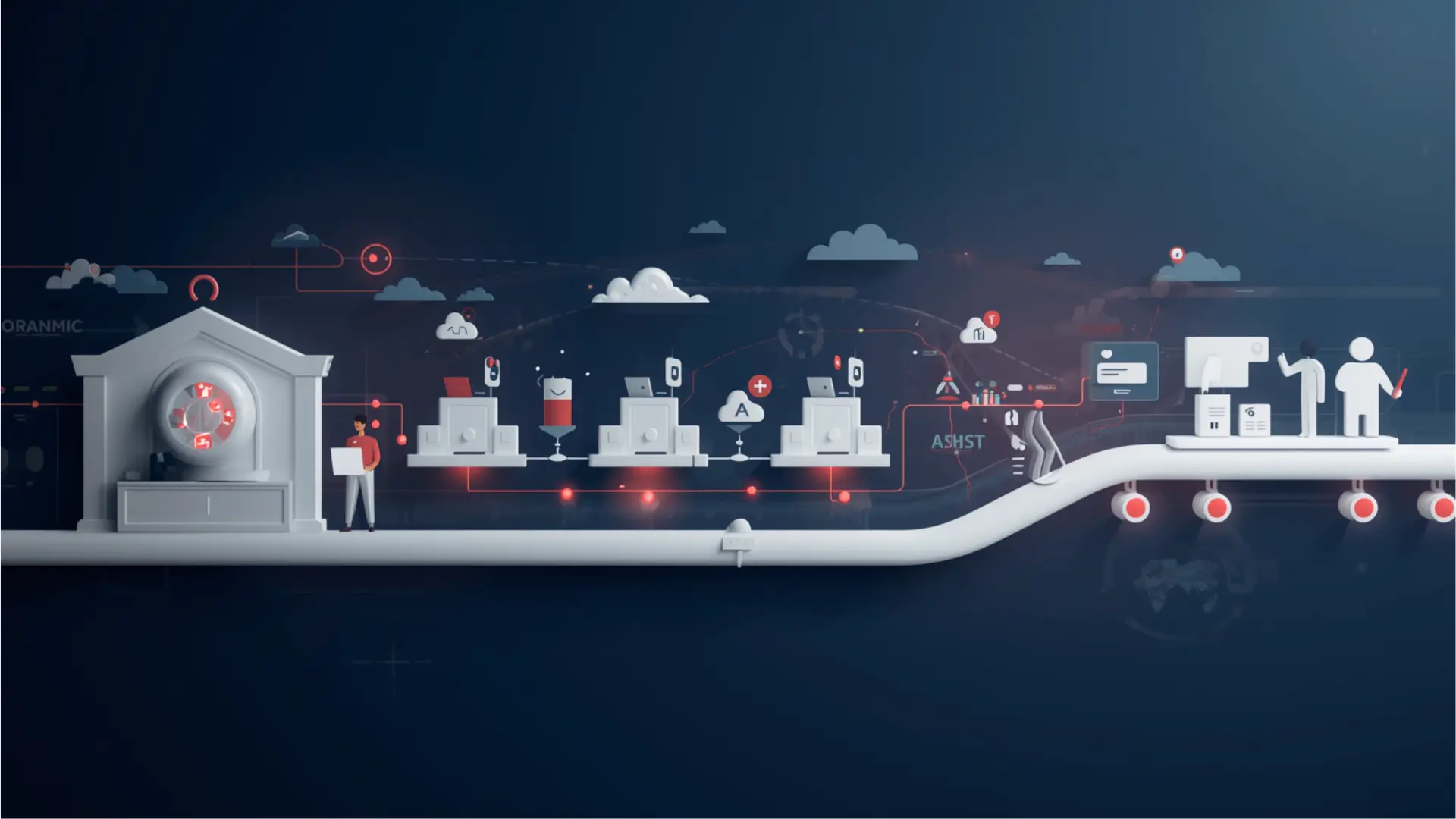
In most modern systems, the process follows a structured sequence. Not as a rigid framework, but as a set of stages that connect into a continuous workflow.
1. AI identifies ideal prospects using real-time data
Prospecting is usually one of the most time-intensive parts of business development. It requires filtering large amounts of information and deciding where to focus.
AI systems approach this differently.
They analyze multiple signals at once, including company size, industry activity, hiring patterns, technology usage, and public updates. Instead of reacting to static lists, the system continuously evaluates which companies are more likely to be relevant at a given moment.
This shifts prospecting from a manual task to an ongoing process.
2. AI researches contacts and decision-makers
Once target accounts are identified, the next step is understanding who within those organizations should be contacted.
AI systems gather information about roles, responsibilities, and context around each potential decision-maker. This includes recent activity, areas of focus, and signals that indicate relevance.
That context becomes important later.
Without it, outreach tends to fall back into generic messaging, even when it is automated.
3. AI creates personalized outreach at scale
This is where most teams start to see immediate impact.
Instead of relying on templates, AI generates messaging based on role, industry, context, and timing. The system can adjust tone, structure, and content depending on how the prospect fits into the broader strategy.
At a surface level, this improves response rates.
But in practice, the real value comes from consistency. The system can maintain a level of activity and personalization that is difficult to replicate manually across large volumes.
4. AI manages follow-ups and books meetings automatically
Follow-up is where many opportunities are lost.
Not because teams do not know what to do, but because consistency breaks down over time. People get busy, priorities shift, and conversations are left incomplete.
AI systems remove that variability.
They track responses, adjust messaging, and continue conversations until there is a clear outcome. When interest is confirmed, meetings are scheduled directly, without requiring manual coordination at each step.
This is where the system starts to feel continuous rather than reactive.
Where most companies struggle
At this point, the system can look complete.
Prospects are identified, outreach is generated, follow-ups are handled, and meetings are booked. On paper, the process works.
The challenge appears when companies try to integrate this into their existing operations.
Outreach improves, but pipeline quality remains inconsistent. Activity increases, but conversion does not always follow. Different teams use the system in different ways, and there is no shared definition of how pipeline should actually be built and managed.
This is not a limitation of the technology.
It is usually a result of how the system is introduced into the business. Without changes in workflows, ownership, and expectations, the impact stays local.
This is typically where teams begin to understand why AI pilots don’t scale inside real operations.
What are the real benefits?
Companies adopt AI business development for practical reasons.
It creates consistency in outreach activity, reduces the time required to generate pipeline, and allows teams to operate without expanding headcount at the same rate.
Over time, this leads to:
- More predictable pipeline generation
- Higher relevance in messaging
- Lower cost per qualified meeting
- Greater ability to scale outreach without adding resources
These benefits are real, but they depend on how the system is implemented.
Without integration into the way the business operates, they tend to remain limited to specific use cases.
Who should use AI for business development?
AI-driven business development is most relevant for organizations where pipeline generation is complex and consistency is difficult to maintain.
This includes:
- B2B companies with longer sales cycles
- Teams that rely heavily on outbound efforts
- Organizations entering new markets
- Companies without full SDR capacity
- Businesses that need predictable lead flow
In these environments, the challenge is not just generating activity. It is maintaining it in a way that produces consistent outcomes over time.
Is AI replacing SDRs?
No.
AI is replacing repetitive work, not strategic work.
Tasks like prospecting, initial outreach, and follow-up require consistency and volume. Those are the areas where AI performs best.
Human teams remain essential for conversations that require judgment, relationship building, and decision-making. Demos, negotiations, and closing processes still depend on people.
What changes is how time is allocated.
Instead of spending most of the effort on generating opportunities, teams can focus on converting them.
Example of an AI Business Development System
A complete system brings these elements together into a continuous process.
One example is a structured system for pipeline generation and outreach execution.
This type of system identifies target accounts, generates tailored outreach, manages follow-ups, and books qualified meetings. More importantly, it operates as a unified workflow rather than a set of disconnected tools.
This is where the difference becomes visible.
Not in individual outputs, but in how consistently the system produces results over time.
Does AI really improve response rates?
Yes, when personalization is based on real context. Generic automation tends to perform poorly, while AI-driven messaging adapts to each prospect.
How long does it take to see results?
Most teams see changes in activity and engagement within a few weeks. More consistent pipeline results depend on how well the system is integrated into existing workflows.
Is AI business development compliant with regulations?
Yes, as long as it follows data privacy and communication regulations such as GDPR and CAN-SPAM.
Do you need technical skills to use it?
Most modern systems require minimal setup. The challenge is usually not technical, but operational.
AI business development is often presented as a way to increase output.
In practice, its impact depends on whether it changes how pipeline is built and managed across the business. When it does, the results tend to be consistent. When it does not, the system remains useful, but limited.
If you are trying to review how your current AI efforts are structured, the starting point is usually not the tool, but how the work around it is defined.