
How Synergy Investing Doubled Outreach Capacity Without Adding Headcount
Synergy Investing transformed its outbound and inbound call operations using AI Digital Employees.
Manual dialing and missed inbound calls were replaced with automated, always-on engagement.
The result was higher contact rates, faster ROI, and scalable growth without new hires.

CASE STUDY
How An Enterprise SaaS Company Reduced Support Headcount by 80% While Increasing Revenue
Industry
SaaS · Sales Development · Customer Support
Solution
AI-Powered Chatbot · Tiered Support Model · SDR Workflow Optimization · Knowledge Base Expansion
- The Challenge
- Why Traditional Solutions Failed
- The Gen AI Solution
- Implementation Approach
- Business Impact
Synergy Investing’s sales operation was constrained by the physical limits of manual calling. Team members spent a significant portion of their day dialing numbers, logging outcomes, and attempting follow-ups, which sharply capped the total number of prospects they could reach. As outreach volume increased, operational friction grew rather than efficiency.
Inbound demand created a parallel problem. Missed calls, especially outside business hours, translated directly into lost opportunities. Leadership recognized that scaling through additional hiring would increase costs without guaranteeing proportional gains in contact or conversion.
To summarize the operational pressure points:
-
Manual dialing restricted daily outreach volume
-
Missed inbound calls led to unrecovered lead loss
-
Follow-up execution depended heavily on individual consistency
-
Hiring additional callers was financially unsustainable
The Gen AI redesigned frontline operations around a tiered AI-human model. An AI-powered chatbot was deployed to manage common customer support interactions, while human agents focused exclusively on complex or sensitive cases.
Simultaneously, SDR workflows were restructured. Instead of reacting to inbound noise, SDRs were redirected toward product-qualified leads, supported by an expanded and structured knowledge base that continuously trained the AI system.
The solution combined:
-
AI-powered chatbot for frontline support
-
Tiered escalation to human agents
-
SDR workflow realignment toward high-value leads
-
Knowledge base expansion for continuous AI learning
Implementation centered on operational realignment rather than tool insertion. The AI chatbot was integrated directly into the existing support platform, with clear escalation thresholds to human agents. Documentation was formalized and expanded to improve AI accuracy over time.
SDR responsibilities were redefined in parallel, ensuring that automation reduced noise rather than shifting it elsewhere. Leadership monitored performance metrics closely to validate that service levels and revenue contribution remained stable or improved.
Key implementation actions:
-
Chatbot integration within existing support channels
-
Defined escalation logic for complex cases
-
Centralized documentation and knowledge management
-
SDR role redesign around qualified engagement
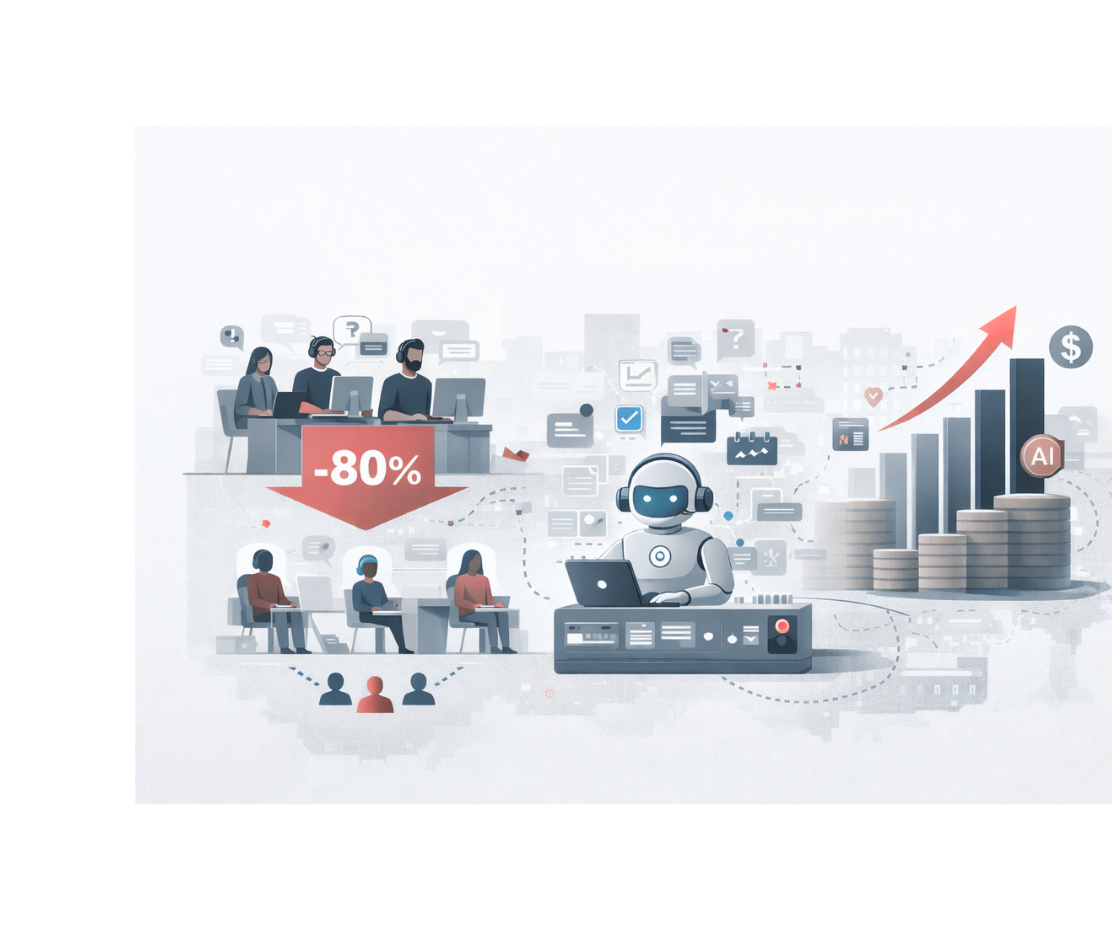
The company reduced its combined Sales Development and Support team from 40 to 8 employees while maintaining operational continuity. More than half of customer chats were handled autonomously by AI, significantly lowering workload for the remaining staff.
Freed from repetitive tasks, SDRs increased their focus on qualified opportunities, resulting in a measurable increase in revenue contribution. Response times improved, and operational costs decreased without compromising support availability.
Measured outcomes included:
-
80% reduction in team size
-
Over 50% of customer chats handled by AI
-
40% increase in SDR-sourced revenue
-
Faster response times across support interactions
Operational Efficiency Gains Powered by AI
Efficiency gains achieved through AI-powered tools, not workforce reduction.
%
Team Size Reduction
%
Revenue Increase (SDR-sourced)
%
Customer Chats Handled by AI
%
AI Support CSAT
Frequently Asked Questions
Did customer satisfaction decline after automation?
AI-handled interactions achieved a 71% CSAT, while human agents maintained higher scores for complex cases.
What happened to the remaining team members?
Remaining staff focused on strategic sales outreach and complex support scenarios.
How was AI trained to handle support requests?
A structured knowledge base was created and continuously expanded to improve AI accuracy.
Was revenue impacted by reducing headcount?
SDR-sourced revenue increased by 40% following the workflow reorganization.
Operational Outcomes
- Support operations scaled without linear cost increases
- SDR productivity improved through focus on qualified opportunities
- Faster response times reduced customer friction
- Knowledge became centralized and reusable across teams
-
Why This Is Different
This was not a chatbot overlay.
The Gen AI redesigned organizational workflows, aligning AI capabilities with human roles to ensure adoption, sustainability, and measurable operational improvement.
More Successful Projects
Real-world AI implementations delivering measurable business impact across industries.

How SunRun Achieved $214k in Annual Efficiency Gains Using AI
By replacing centralized video production with AI Digital Employees, SunRun eliminated travel costs, recovered field productivity, and generated $214,700 in annual business impact, without reducing headcount.

Reducing Internal Coordination by 65% with AI Agents and Workflow Automation
How a creative and marketing agency automated scheduling, proposals, and project briefs using AI agents integrated directly into Slack.
Scaling SaaS Support While Reducing Headcount by 80% Using AI Automation
How a fast-growing SaaS company reduced frontline support costs, increased revenue by 40%, and maintained customer satisfaction with AI-powered support.